

Reference: Questionnaire Notification No. 8CPC/2026/01.
Deadline: March 16, 2026.
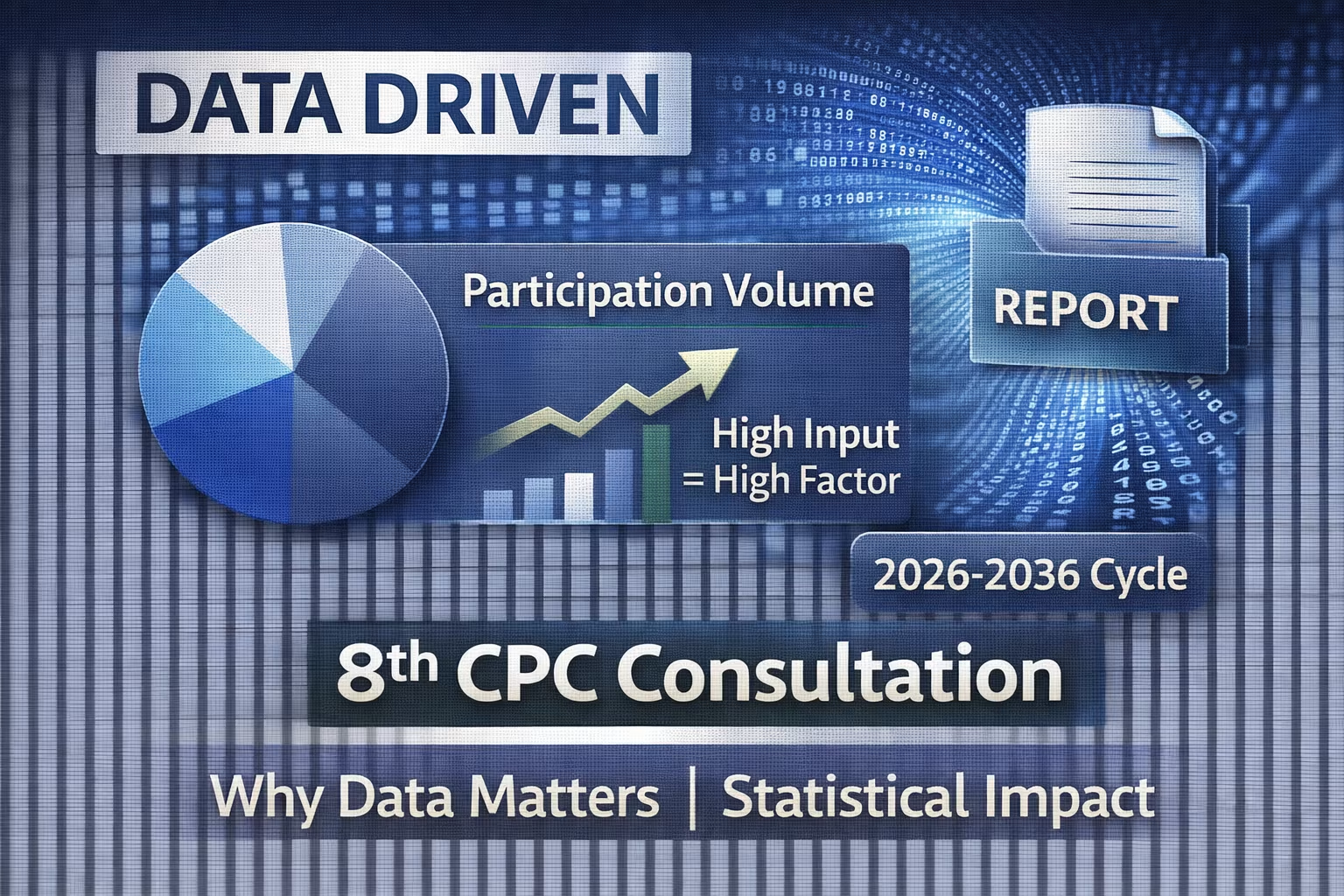
New Delhi: The 8th Central Pay Commission (CPC) has commenced its stakeholder consultation process via the official portal 8cpc.gov.in. Participation in this survey is a critical administrative exercise. The Commission utilizes the aggregated data from these responses to determine the “Satisfaction Index” regarding current pay and pension structures. A lack of sufficient data points from employees may lead to the statistical assumption that the existing structure requires only minimal revision (based on inflation indexation) rather than a structural upgrade.
Data Significance: The Pay Commission functions as a data-processing body. While Unions submit policy memorandums, the Commission requires individual user data to validate these demands scientifically. The volume of responses directly correlates to the weightage assigned to specific anomalies in the final report.
1. Statistical Implication of Non-Participation
The Commission analyzes feedback to calculate the Fitment Factor. The current government projection stands at approximately 1.96. The Staff Side demand is 3.68. The gap between these two figures is bridged by “Evidence of Inadequacy.”
Impact Scenarios:
- Low Response Volume: If the sample size is small, the Commission may rely heavily on the Consumer Price Index (CPI) data alone, leading to a conservative Fitment Factor (approx 1.96).
- High Response Volume: A large dataset reporting specific financial deficits (e.g., HRA insufficiency, Pension gap) compels the Commission to record these as “Verified Anomalies,” necessitating a higher correction factor (closer to 3.68).
2. Evidence for Pension Revision (OPS/NPS)
The Terms of Reference (ToR) mandate the Commission to “Examine” the pension structure. Examination is evidence-based.
If employees do not explicitly record technical objections to the Unified Pension Scheme (UPS)—specifically regarding the “Average Pay” formula—in Question 12, the final report may lack the evidentiary basis to recommend a return to the Defined Benefit (OPS) model. Administrative silence is often interpreted as acceptance of the status quo.
3. Long-Term Policy Lock-in (2026–2036)
Pay Commission recommendations are implemented for a ten-year cycle. The parameters finalized in the 2026 report will govern:
- Annual Increment Rate: (Review of the current 3% rate).
- Promotion Hierarchy: (MACP benchmarks).
- Allowances: (HRA, CEA, and Transport Allowance rates).
Non-participation in the current window (Feb–March 2026) precludes employees from raising structural grievances after the notification is gazetted.
4. Procedural Requirement for All Cadres
Submission of the questionnaire is open to all serving employees and pensioners. It is distinct from the Joint Consultative Machinery (JCM) memorandum.
- Entry Level (Level 1-5): Data required on Minimum Pay adequacy.
- Mid-Level (Level 6-10): Data required on HRA and Transport Allowance.
- Senior Level & Pensioners: Data required on Commutation and Medical Allowance.
हिंदी सारांश: 8वां वेतन आयोग सर्वे – भागीदारी का महत्व
प्रशासनिक महत्व: वेतन आयोग डेटा के आधार पर फैसले लेता है। यदि कर्मचारी सर्वे में भाग नहीं लेते, तो आयोग मान लेगा कि वर्तमान वेतन (₹18,000) पर्याप्त है।
फिटमेंट फैक्टर पर असर: 3.68 फिटमेंट फैक्टर पाने के लिए यह साबित करना जरूरी है कि वर्तमान वेतन कम है। यह केवल आपके सर्वे डेटा से साबित होगा।
भविष्य पर प्रभाव: यह रिपोर्ट अगले 10 साल (2036 तक) के लिए नियम तय करेगी। इसलिए 16 मार्च 2026 से पहले अपनी राय दर्ज कराना अनिवार्य है।
📲 WhatsApp पर शेयर करें


Yes figments fecter may be raised
Yes sir, all the speculations are in same direction but the survey submission is needed for the positive results