
NPS Partial Withdrawal Rules 2026: PFRDA 25% Limit & Self-Declaration Guide
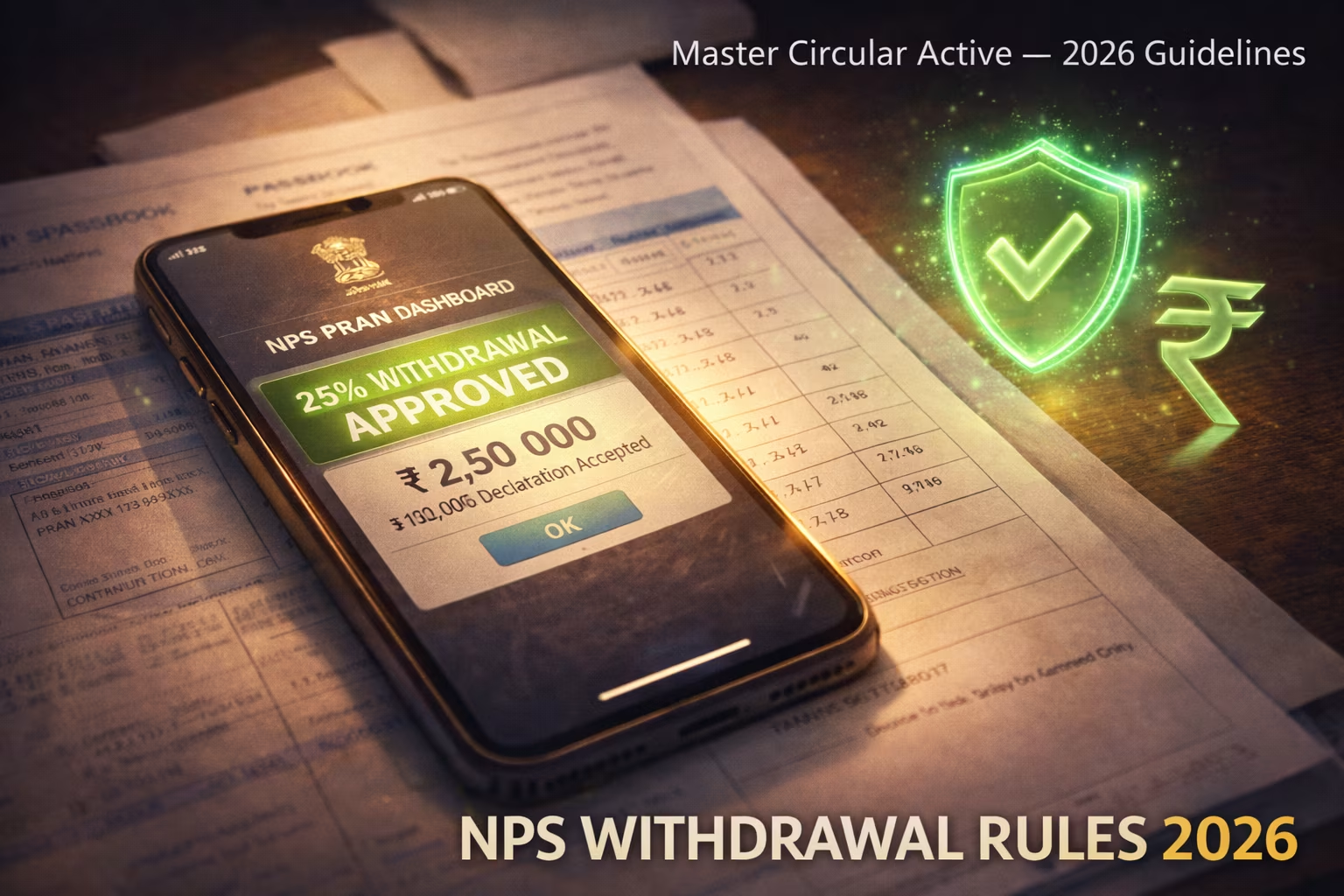
The Pension Fund Regulatory and Development Authority (PFRDA) has strictly streamlined the National Pension System (NPS) partial withdrawal rules for 2026. Central Government employees and standard subscribers can now withdraw up to 25% of their accumulated corpus for specific emergency and life-event needs without relying on complex nodal office approvals.
Authority: Pension Fund Regulatory and Development Authority (PFRDA)
Applicability: All Central Govt, State Govt, and Corporate NPS Subscribers
A major trap that causes thousands of withdrawal rejections is the miscalculation of the 25% limit. In practice, many employees assume they can withdraw 25% of their total accumulated NPS corpus. However, the PFRDA rules strictly mandate that the 25% limit applies only to the employee’s own contribution, completely excluding the government/employer’s matching contribution and the accrued interest.
What are the approved reasons for NPS partial withdrawal?
Subscribers cannot treat the Tier-I NPS account like a standard savings bank account. Partial withdrawals are strictly ring-fenced and permitted only for major life events and critical emergencies defined by the regulatory authority.
| Authorized Purpose for Withdrawal | Applicable Conditions |
|---|---|
| Higher Education of Children | Includes legally adopted children |
| Marriage of Children | Includes legally adopted children |
| Purchase/Construction of Residential House | Not applicable if subscriber already owns a house (except ancestral property) |
| Critical Illness Treatment | For self, spouse, children, or dependent parents (e.g., Cancer, Kidney failure, Stroke) |
| Skill Development / Reskilling | Self-development courses to enhance employability |
Withdrawal Limits, Gap Rules, and Frequency
To protect the retirement compounding effect, the PFRDA has placed rigid caps on how often and how much an employee can withdraw during their entire service tenure.
Minimum 3 years of continuous NPS membership
Maximum 25% of employee’s own contribution
Self-declaration mechanism for faster processing
Maximum 3 partial withdrawals in entire lifetime
Mandatory 5-year gap between two withdrawals (except for critical illness)
Employer contribution cannot be touched
Does the 5-year gap rule apply to medical emergencies?
No. The PFRDA provides a crucial humanitarian exemption. If a subscriber or their dependent family member is diagnosed with a specified critical illness (such as cancer, major organ transplant, or severe accidents), the mandatory 5-year gap rule between two partial withdrawals is completely waived.
How To Apply Using the Self-Declaration Method
To ease the administrative burden on Pay and Accounts Offices (PAO) and Drawing and Disbursing Officers (DDO), PFRDA has introduced the “Self-Declaration” framework. Subscribers no longer need to submit heavy physical proof (like medical bills or marriage cards) to their nodal office for most withdrawal categories.
- Log in to your CRA (Central Recordkeeping Agency) system using your 12-digit PRAN and password.
- Navigate to the ‘Transact Online’ tab and select ‘Partial Withdrawal from Tier I’.
- The system will auto-calculate and display the maximum eligible withdrawal amount (25% of your own contributions).
- Select the purpose of withdrawal from the drop-down menu.
- Accept the digital Self-Declaration stating that the funds will be used strictly for the selected purpose.
- Authenticate the transaction using the OTP sent to your registered mobile number and email ID.
- The funds will be credited directly to your registered, penny-dropped verified bank account within T+2 working days.
Can the nodal office reject my self-declaration?
While the self-declaration speeds up the process, nodal offices (for Govt employees) or POPs (for private citizens) retain the right to flag suspicious requests. If a subscriber is found misusing the funds for unauthorized purposes, it constitutes a violation of the PFRDA Act, and future withdrawal rights may be suspended.
Frequently Asked Questions
How much amount can I withdraw from my NPS Tier-I account?
You can withdraw a maximum of 25% of your own total contributions made to the Tier-I account, excluding the employer’s contribution and the returns generated on the corpus.
What is the minimum lock-in period before the first NPS partial withdrawal?
A subscriber must complete a minimum of 3 years as a member of the National Pension System (NPS) from the date of their PRAN generation to be eligible for their first partial withdrawal.
How many times can I make a partial withdrawal from NPS?
A subscriber is allowed a maximum of three (3) partial withdrawals during their entire subscription tenure under the NPS.
Do I need to submit medical bills or marriage cards for withdrawal?
No. Under the latest PFRDA guidelines, physical documentary proof is generally not required. The withdrawal is processed based on a digital Self-Declaration submitted by the subscriber via the CRA portal.
हिंदी सारांश
पेंशन निधि विनियामक और विकास प्राधिकरण (PFRDA) ने राष्ट्रीय पेंशन प्रणाली (NPS) से आंशिक निकासी (Partial Withdrawal) के नियमों को सरल कर दिया है। अब सरकारी और निजी कर्मचारी बच्चों की उच्च शिक्षा, विवाह, घर खरीदने या गंभीर बीमारी के इलाज के लिए अपने टियर-1 (Tier-I) खाते से पैसा निकाल सकते हैं। ध्यान दें, आप केवल अपने द्वारा जमा की गई राशि का अधिकतम 25% ही निकाल सकते हैं (सरकार/नियोक्ता का हिस्सा और ब्याज इसमें शामिल नहीं है)। पूरे सेवाकाल में केवल 3 बार निकासी की अनुमति है, जिसके लिए अब ‘सेल्फ-डिक्लेरेशन’ (Self-Declaration) के जरिए ऑनलाइन आवेदन किया जा सकता है।
Share This in Office WhatsApp Group


